


Camí de Cavalls. Stage 5:
Cala Tirant – Cavalleria beach – Binimel·là
Stage 5 of the Camí de Cavalls crosses one of the best-preserved coastal areas of Menorca. The scenic richness of the route is enhanced by the ever-present silhouette of Cape Cavalleria.
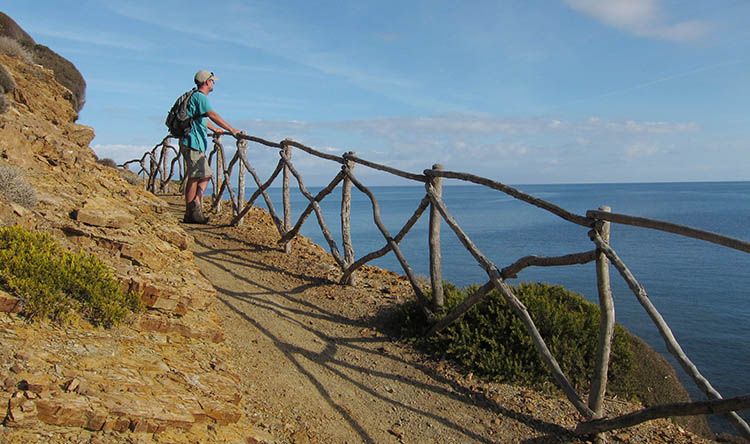
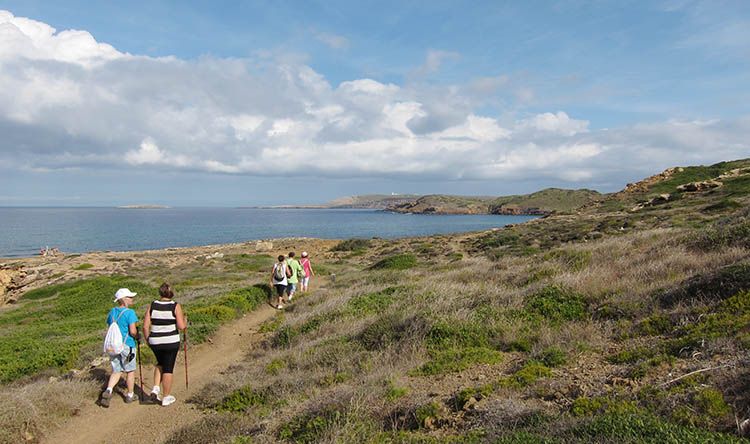
This stage of the Camí de Cavalls begins at Cala Tirant, where you have to cross over the stream behind the beach on a wooden footbridge. Continue along a broad track and then take a footpath that more or less hugs the coastline as far as the remains of the Roman city of Sanitja on Cap de Cavalleria. From here, pick up the road south as far as the car-park for the beach of Cavalleria. Once across this beach, the Camí de Cavalls follows the coast on a switchback path with excellent views of the north coast of Menorca as far as Cala Mica in about 40 minutes. From here to the end of the stage at the beach of Binimel·là will take you around 30 minutes.
Distance: 9,6 km • Difficulty: Average • Estimated walking time peu: 3 h
Be sure to shut all gates after you since they are used to control the cattle
Keep an eye out for cars along the small stretch that runs along the road. In summer this road can be quiet busy and there are no facilities for pedestrians.
SHORTER ALTERNATIVES AVOIDING ROADS
If you walk these two stretches separately, you will avoid 1.325 km of road
Cala Tirant → Cap de Cavalleria
Distance: 4,7 km • Difficulty: Average • Estimated walking time: 1 h 30 min
Platja de Cavalleria → Platja de Binimel·là
Distance: 3,6 km • Difficulty: Average • Estimated walking time: 1 h 10 min

The surroundings
This stage of the Camí de Cavalls passes through one of the best-preserved parts of the Menorcan coastline. For this reason, the EU has declared it to be an Area of Community Importance (LIC) and a SPA (Special Protection Area) for birds. It is also of remarkable geological and botanical interest: low scrubby vegetation dominates with rosemary, winter heath, chamomile and Phoenician juniper, along with good populations of the endemic socarrell plants, characterized by their compact, spiny, hemispherical forms. The beaches of Cavalleria, Tirant and Binimel·là boast ecologically rich dune systems, while behind both Cala Tirant and the beach at Binimel·là there are small wetlands. The scenic beauty of this stage is completed by the omnipresent Cap de Cavalleria and its lighthouse, which stands aloft the imposing cliffs of the headland.
Don’t miss
• Roman city of Sanitja: Remains of the Roman city of Sanisera (first century BC–sixth century AD) located around the natural port of Sanitja on Cap de Cavalleria. The excavations carried out here have revealed that this Roman city was a very important trading port.
Nearby sites of interest
• Sanitja tower:Defence tower built by the English in 1801 during their third period of occupation (1798-1802). It stands at the entrance to the port of Sa Nitja.
• Cavalleria lighthouse: Standing on the tip of Cavalleria cape atop some of the island’s highest and most imposing sea-cliffs, this is the most northerly point of Menorca and offers wonderful views of its northern coastline. More information. More information.
• Wetland Lluriac: Coneguda Also known as the Prat de Lluriac, this is one of the most important wetlands on the island and is a must-visit site for birdwatchers. It lies next to the track that joins the Camí de Tramuntana to the far western end of Cala Tirant.
Services
• Cala Tirant: The resort of Platges de Fornells provides all types of facilities for beach-users.
• Cavalleria beach: No facilities.
• Binimel·là beach: A restaurant is the only facility on this beach.
How to get there
Cala Tirant is 20 km from Maó and 8 km from Es Mercadal. To get there, turn right along the road 2 km before reaching Fornells.
To reach the beaches of Cavalleria and Binimel·là from Es Mercadal, take the road to the northern beaches as far as the Camí de Tramuntana. Turn left along this road and after 1 km you will come to Carretera de Cavalleria on your right. If you continue straight on along the Camí de Tramuntana for 2 km more, you will reach the track to the beach at Binimel·là.
Tirant and beaches of Cavalleria and Binimel·là have car-parks.
In summer, a bus connects Maó and Es Mercadal with the urbanized areas of Platges de Fornells. Check out bus times and frequencies (that vary according to the season).
Accommodation and logistics on Camí de Cavalls
Search accommodation in cala Tirant (Playa de Fornells).
If you want to go through the Camí de Cavalls in stages, either a part or all of it, you have to plan your trek well. There are no accommodation for trekkers on the path, so you will have to make use of the touristic accommodations you will find on the route. That is the reason why making the route outside the tourist season could be somewhat complicated.
Also, you have to bear in mind that there are sections where you will not find any kind of accommodation for kilometres around. That is the case of the 33,5 km section between Cala Tirant and Cala Morell. It is important to adapt the route plan to your physical condition and your experience as a trekker. In many cases, the ideal choice is to hire a logistic service for you to resolve those shortcomings. This way, you will be able to get the most out of the experience.
Camí de Cavalls 360º is a specialised travel agency that helps you to make the route in stages, in a self-guided manner and with a series of related services (among others, accommodation and logistics). Camí de Cavalls 360º offers you different choices to traverse the Camí de Cavalls with autonomy, always adapting to your needs.
Map
See all stages of the Camí de Cavalls
The Camí de Cavalls is divided up into 20 stages that can be walked as a single long hike or individually in sections, or can be used simply as somewhere go for a stroll. Discover Menorca here describes the official stages as 20 separate day-long walks, using the morning for the outward bound stretch and the afternoon for the return.
This stage of the Camí de Cavalls passes through a fine example of a windswept coastal landscape, especially between Sa Mesquida and the Macar de Binillautí.
All of this stage of the Camí de Cavalls runs through S’Albufera des Grau Natural Park. It is an excellent walk for getting to know a variety of different habitats…
Much of this stage of the Camí de Cavalls runs through the S’Albufera des Grau Natural Park and many of its very diverse landscapes.
This stage of the Camí de Cavalls begins at the far western end of the built-up area of Arenal d’en Castell. Walk for 10 minutes along the cliff-top path as far as Son Parc…
This stage of the Camí de Cavalls passes through one of the best-preserved parts of the Menorcan coastline. The EU has declared it to be an Area of Community Importance and and a Special Protection…
This is the longest and hardest of all the stages of the Camí de Cavalls and, unsurprisingly, also one of the most spectacular.
This stage of the Camí de Cavalls is characterized by the number of different habitats it visits. Around Cala Pilar a large number of endemic plants thrive alongside the more typical plants of…
This stage of the Camí de Cavalls leaves the fertile and wooded area of La Vall d’Algaiarens to enter a landscape dominated by low, scattered vegetation and ends at Cala Morell, one of Menorca’s geological jewels.
This stage of the Camí de Cavalls runs entirely through what is known as dry Menorca, characterized by sparse vegetation and endless rows of dry stone walls, ending near the Punta Nati lighthouse.
This stage of the Camí de Cavalls, between Punta Nati and Pont d’en Gil runs through what is known as “Dry Menorca”, characterized by sparse vegetation and endless rows of dry-stone walls. It then passes through several residential areas before reaching Ciutadella de Menorca.
From Cala Blanca onwards and as far as the end of the stage, the flat path follows low coastal cliffs that harbour an interesting plant community.
This stretch of the Camí de Cavalls is flat and climbs very little. The landscape over much of this stage is dominated by a rocky coastline alternating with small coves.
One of the great attractions of stage 13 of the Camí de Cavalls are the unspoilt beaches of Cala en Turqueta, Macarella and Macarelleta, some of the most iconic — and also overcrowded — beaches on the southern coast of Menorca.
If you want to discover what the forests of Menorca’s southern coast are like, this stage of the Camí de Cavalls is a great opportunity, taking you through Cala Mitjana, one of the unspoilt coves on the southern coast that draws the most visitors during the summer months.
The route of stage 15 of the Camí de Cavalls is flat and not very rugged, never reaching any significant elevation. Even so, it passes through quite varied habitats, such as urban areas, inland ravines, low rocky coastline, coastal dunes, fields and pastures.
The route of stage 16 of the Camí de Cavalls runs almost entirely inland, connecting two important ravines on the southern coast of Menorca: the Llucalari ravine and the Cala en Porter ravine.
Stage 17 of the Camí de Cavalls runs almost entirely through the interior, crossing ravines along the southern coast, alternating with the typical Menorcan mosaic landscape of croplands, pastures and small wild olive groves.
Stage 18 of the Camí de Cavalls runs almost entirely through streets and paved roads of numerous residential developments, with the exception of two small remaining dirt path sections at the beginning and end of the route.
Stage 19 of the Camí de Cavalls covers part of the eastern coast of Menorca and crosses the Rafalet ravine. Along the way, it passes important vestiges of the island’s military history, such as the Alcalfar tower and Fort Marlborough, in Cala Sant Esteve, at the end of the stage.
A 100% paved and mainly urban stage that connects and crosses the towns of Maó and Es Castell, walking parallel to the Port of Maó.
The best walks and excursions around the coast of Menorca along the Camí de Cavalls (GR-223), an ideal way of exploring the island’s coastline at your leisure. Unspoilt beaches, rocky outcrops, pinewoods and sea-cliffs step-by-step.
The Menorcan interactive map with the 20 stages of the Camí the Cavalls (GR 223) and much more…