


The Talayotic culture of Menorca
Menorca preserves an outstanding network of prehistoric monuments, turning the island into a true open-air museum. The taulas, navetas and talayots are the most characteristic megalithic constructions found in Menorca’s archaeological sites. Discover them.
What is known as Talayotic Menorca covers the first 2,000 years of human occupation on the island, forming the period of the prehistory of Menorca. The Talayotic culture includes the customs and techniques of the prehistoric societies of the Balearic inhabitants, up until the Roman conquest in 123 BCE. The vast majority of archaeological remains of the Talayotic culture can be found in Menorca, where most of this heritage is located. The Talayotic Menorca was recognized by UNESCO as a World Heritage Site in 2023, organizing the sites into nine territorial areas that include 280 archaeological sites (and their associated landscapes), out of the more than 1,500 inventoried in Menorca. This makes it the island with the highest number of prehistoric sites per km² in the world.
In this video, “Talayotic Menorca, an insular cyclopean odyssey“, you can learn about the different periods and remains of Talayotic Menorca with various experts.
The periods of Talayotic Menorca
During these 2,000 years, the way humans lived on the island gradually changed. The first inhabitants of Menorca went from living a semi-nomadic lifestyle, using pastures for their herds and gathering food, to living in sedentary communities that transformed and controlled the landscape, developing strategies to exploit the environment in order to ensure their subsistence. This process has been divided into different periods and, depending on the sources consulted, you may find different periodization formulas for the prehistory of Menorca. Below is the proposal made by the Social Archaeology of the Mediterranean Research Group at the Autonomous University of Barcelona, which divides the prehistory of Menorca into five different periods:
Dolmenic Period (2100–1600 BCE)
The first settlers of Menorca formed small family clans who lived semi-nomadically. Their dwellings are unknown, but they were likely natural caves or small huts. The dolmens of Ses Roques Llises and Montplà are burial tombs from this period.

Naviform Period (1600–1050 BCE)
During this period the population increased, likely due to new waves of migration. Although still mainly herders and gatherers, the population became sedentary and the first evidence of cereal cultivation appears. Activities such as metallurgy and mining began. Exchanges were established between settlements, even reaching the neighboring island of Mallorca. As for housing, the cyclopean technique began to be used to build houses shaped like an inverted ship. These naviform houses are the origin of the name naveta. Burials, however, remained collective and took place in natural caves, although the first burial navetas began to be built. The hypogeum of Torre del Ram and the sites of Son Mercer de Baix and Caparrots de Forma date from this period.

Prototalayotic Period (1050–850 BCE)
In this period naviform houses were abandoned and the population concentrated in larger settlements. It was the peak period of burial navetas, as demonstrated by the famous Naveta des Tudons and those of Rafal Rubí.

Talayotic Period (850–550 BCE)
The name Talayotic culture comes from the talayots, truncated-cone stone towers probably used as watchtowers and defensive structures. Most of the 300 talayots scattered across the island were built during this period. They are found isolated or within settlements, sometimes with more than one talayot. Some of the best-preserved talayots are those of Torelló, Trepucó and Cornia Nou.

Postalayotic Period (550–123 BCE)
Communities of this period continued to live sedentarily in the same settlements, but the talayots gradually lost prominence. During this period the taula enclosure, a religious construction, became the central building of the settlements. The best examples of these unique structures are the taulas at the sites of Torralba d’en Salort, Trepucó and Talatí de Dalt.
In this period, houses followed a standard construction pattern and were often built attached to one another, as can be seen in the settlement of Torre d’en Galmés. Although livestock remained important, agriculture became the island’s main economic activity and the first tools related to fishing appeared. Funerary practices took place in necropolises of large artificial caves such as those of the Cala Morell necropolis.
Contacts with other Mediterranean cultures intensified and, during this period, the Balearic slingers fought as mercenaries in the Punic wars, for both the Carthaginian and Roman armies. In 123 BCE Menorca was conquered and incorporated into the Roman Empire, although the Talayotic culture would take several more centuries to disappear. A helpful and entertaining way to place this period of Menorca’s prehistory in context is to think of the time of the famous comic characters Asterix and Obelix.

The 10 most outstanding monuments of Menorca’s Talayotic culture
The Talayotic monuments of Menorca have exceptional value due to their construction techniques, their good state of preservation, their monumentality and the large number concentrated in a very small area. In just 700 km² of the island’s surface there are more than 1,500 sites. For this reason, this heritage is currently recognized as a UNESCO World Heritage Site.
Among all the Talayotic sites that can be found in Menorca, we highlight the following 10 monuments for their spectacular nature and ease of access.
Naveta des Tudons
The most emblematic monument of Talayotic Menorca, both for its excellent state of preservation and because navetas are funerary constructions found only in Menorca. More information about Naveta des Tudons.

Talayotic settlement of Torre d’en Galmés
The largest in Menorca and one of the biggest in the Balearic Islands. The settlement is highly monumental and preserves a wide variety of remarkably well-built structures. It stands on a hill with a perfect panoramic view over much of Menorca’s south coast. More information about the Talayotic settlement of Torre d’en Galmés

Talayotic settlement of Son Catlar
The settlement of Son Catlar stands out because it is the only Talayotic settlement in the Balearic Islands that preserves its cyclopean wall almost intact. Although the settlement itself is not in very good condition, you can walk around the exterior path and admire the wall. For that alone, Son Catlar is worth a visit.

Talayotic settlement of Torralba d’en Salort
One of the largest and most spectacular prehistoric settlements in Menorca. The settlement reached its peak during the Punic commercial expansion and continued to be used until medieval times. The taula and its enclosure are the most spectacular remains of this settlement. More information about the Talayotic settlement of Torralba d’en Salort.

Talayotic settlement of Talatí de Dalt
One of the most emblematic on the island due to its good state of preservation and the peculiar taula where a column rests on its horizontal slab. More information about the Talayotic settlement of Talatí de Dalt.

Talayotic settlement of Trepucó
One of the largest Talayotic settlements in Menorca, covering nearly 5,000 square meters, of which only a small part remains today: sections of the wall, two talayots, the taula enclosure and some house remains. More information about the Talayotic site of Trepucó.

Talayotic settlement of Torrellafuda
Talayotic settlement inhabited until the Islamic period, as shown by archaeological remains found there. It is located within a wild olive forest and consists of a large talayot, a taula enclosure, various houses and a necropolis made up of four artificial caves. More information about the Talayotic settlement of Torrellafuda

Necropolis of Cala Morell
The most spectacular necropolis on the island, made up of a group of 17 artificial caves. The interior of some of the largest hypogea was intended to imitate the circular houses of the Talayotic period, with uneven levels or columns carved from the rock itself. More information about the necropolis of Cala Morell.

Talayotic settlement of Torretrencada
Notable for its taula, which preserves a pilaster at the rear. A talayot, remains of the wall that enclosed the site, foundations of possible houses and several hypogea complete the settlement. More information about the Talayotic settlement of Torretrencada.

Talayot of Torelló
One of the largest and best-preserved talayots in Menorca, which preserves a doorway with a lintel at the upper part of the monument, originally part of the settlement of Torelló.

Map of the most important megalithic monuments in Menorca
View the map of Talayotic Menorca on Google Maps.
Map of the Menorca Talayotic monuments declared World Heritage
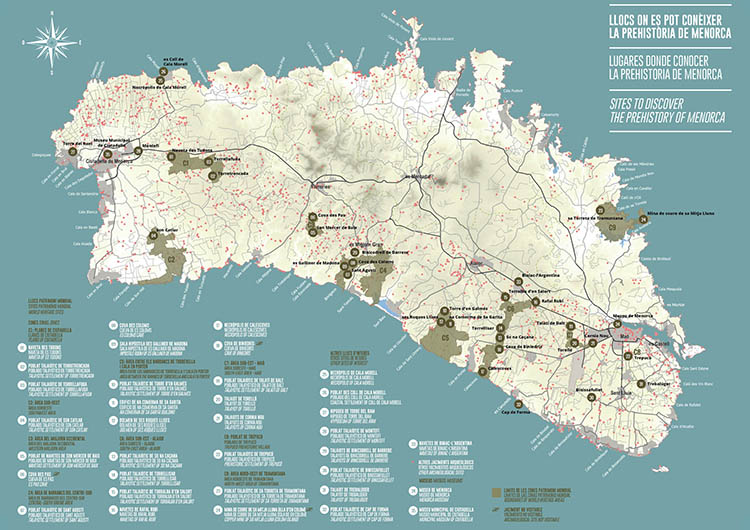
Click on the map to view it online. Source: Menorca Talaiòtica. World Heritage Candidate. Consell Insular de Menorca.
In conclusion, the Talayotic culture of Menorca is one of the most exceptional archaeological legacies in the Mediterranean. With an unparalleled density of prehistoric sites and unique monuments such as the navetas, the taulas and the talayots, the island becomes a true open-air museum that bears witness to more than 2,000 years of history. The recognition of Talayotic Menorca as a UNESCO World Heritage Site reflects its universal value, the preservation of its remains and the importance of this legacy in the history of humanity. Whether you are interested in prehistory, archaeology or Mediterranean culture, discovering Menorca’s Talayotic sites will allow you to connect with the first societies that shaped this unique island.
The Talayotic culture refer to the customs and skills of the pre-historic inhabitants of the Balearic Islands up to the Roman conquest (123 BC). Most of the archaeological remains that have been excavated –of which most are on Menorca – correspond to the so-called Talaiotic culture that can be dated from around 1,000 BC.
The Naveta des Tudons is a pre-Talayotic funeral building in use from 1200 to 750 BC. It consists of a collective tomb that was found to contain the remains of at least 100 graves…
This spectacular necropolis with 14 burial chambers hewn from the bare rock is to be found in a small gully just before Cala Morell to the north of Ciutadella.
Torre d’en Galmés is one of the largest Talayotic sites in the Balearic Islands and is well worth a longish, unhurried visit to ensure that you appreciate all its finer points.
Torrellafuda is a small Talayotic site with unrestricted access that stands in a shady old wild-olive grove. You will find the remains as soon as you begin to walk along the access track.
A visit to the Talayotic settlement of Talatí de Dalt, which blends in so harmoniously with its surroundings, is always a memorable experience.
The site of Son Catlar is of great interest as the only Talayotic settlement in the Balearic Islands whose surrounding cyclopean wall is all but intact.
Despite being somewhat hidden-away and smaller than other Menorcan sites, the Talayotic settlement of Torretrencada is still well worth a visit.
Torralba d’en Salort is remarkable for its enormous taula and its enclosure. This taula is one of the largest on Menorca and is perfectly preserved.
Covering 5,000 m2, Trepucó is one of the largest Talayotic sites in Menorca, even although only a small part of the original settlement has been preserved.